
Golf Course Development Plans
Driving range, golf carts are out of bounds in a crowded city park and residential area
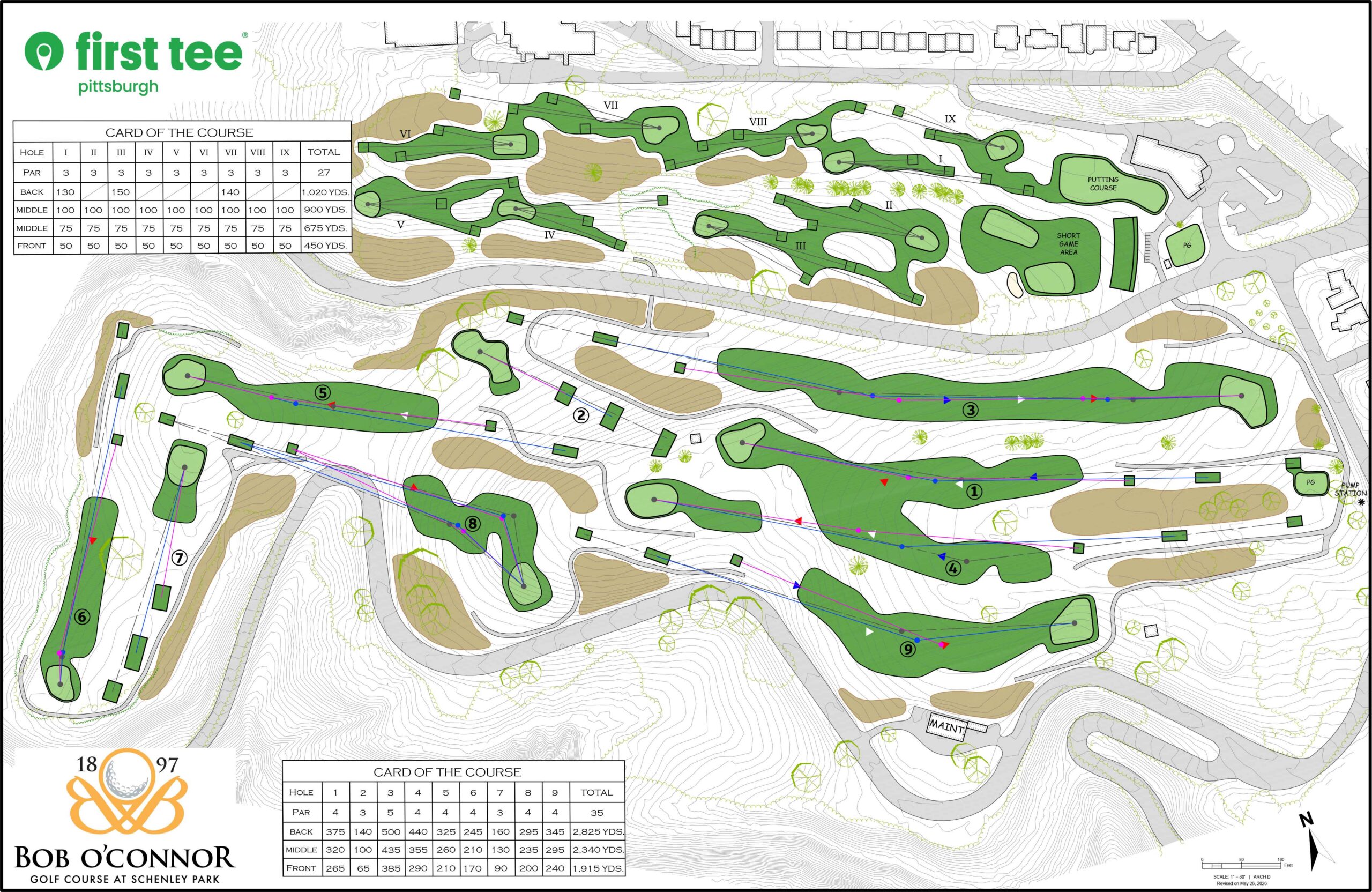
Since 2007, First Tee of Pittsburgh has operated Schenley Park’s golf course under a lease agreement with the City of Pittsburgh. In November 2025 First Tee hosted a community meeting to revive plans for a driving range, golf carts, and other alterations to the course.
Approximately 60 neighbors attended the meeting. Many expressed concern that such changes would increase car traffic and parking both in the park and on Squirrel Hill streets, and would diminish the park’s natural attributes through increased noise, additional lighting and other environmental impacts. Concern was also raised about a plan by the city to locate a Department of Public Works maintenance building in the park, across the road from the current golf course maintenance building.
Neighbors requested regular community meetings to learn more about First Tee’s proposal, and there was broad agreement that any development should strengthen Schenley Park’s stewardship and community use, not just golf programming.
“The golf course should be considered an environmental amenity that can enhance and grow the natural systems in the park.”
Summary of Concerns for Schenley Park Golf Course Expansion - April 2026
Many concerns have been raised regarding the proposed expansion of the Schenley Park (Bob O’Connor) golf course. These include physical and sensory environmental impacts as well as traffic impacts, as summarized below.
-
Significant concerns have been expressed that adding a full-size driving range and an expanded golf course will negatively affect open green space and the natural park environment.
Wetlands & Stormwater: The proposed driving range, hard surface cart paths (5-6 feet wide), new maintenance garage (cart barn), and additional parking lots will drasticallyincrease impervious surfaces. These proposed features potentially add an acre or more of new hard surface which will increase rain runoff. That reduces the ground’s ability to absorb stormwater. More impervious surfaces increase runoff that could carry fertilizers, turf chemicals, and fuel or oil leaks from vehicles and carts directly into tributaries of Phipps Run and Panther Hollow Run into Panther Hollow Lake, ultimately draining into the Monongahela River.
Trees: Mature trees would likely need to be removed to make room for a cart shed building, driving range netting and poles, and hard surface cart paths. This will strip parts of the park of shade, carbon absorption, and natural beauty. Even trees left standing may face interference from driving range netting encroaching on the canopy. Any tree removal should only happen through formal arborist assessments, not for commercial convenience.
Infrastructure: The cart path network alone is estimated at 1-2 miles if 3,000+ yard course is fully equipped with hard surface cart paths. Cart paths would require extensive ground disturbance across the course. Due to the hilly nature of the park, some cart paths may require hillside modifications to avoid carts tipping or slipping on wet grass. Electric golf carts would demand new electrical infrastructure for nightly charging stations. Gasoline or propane carts, if these are intended, require fuel storage tanks. Vehicles and their storage areas risk soil and groundwater contamination from fuel and oil leaks. The large storage or maintenance facility for golf carts (referred to as a “cart barn”) is estimated to be 2,500 sq. ft. for possibly 20-25 carts and is being considered at the southeastern corner of the park (near the intersection Darlington Road and Circuit Drive). The new building may be only part of a plan that includes a manned pay station, vending machines and toilet facilities (the location is nearly 1,000 feet from the main clubhouse). This would be a large steel building in the park for a nine-hole course that is used for golf only about seven months of the year, while the park itself is used year-round by neighbors and residents from across the city.
Altering the Landscape: The driving range and expanded 9-hole golf course would fundamentally reshape a 127-year-old park course. The Schenley Park course never required this kind of maintenance building and built infrastructure. "Reshaping" the land underneath the golf course changes natural drainage patterns and the character of this part of Schenley Park. This plan converts recreational open green space (for picnics, hiking, sledding, skiing, walking, kids’ play) into a single-use commercial revenue increasing facility. Altering the park in this way results in permanent alterations to what has historically been a flexible, natural public space.
Wildlife displacement: Schenley Park is the home to deer, owls, foxes, songbirds — a noisy driving range (possibly lit) and a new golf cart storage facility and parking lot at the southeastern corner can drive wildlife away. The many birds that live in or migrate through the park each year, using it as a critical stopover habitat, will be negatively affected by an expanded golf course and driving range which creates impediments to breeding and safe migration.
Bottom Line: The bottom line is that golf course expansion proposal would potentially cause serious, irreversible environmental harm to a historic public park. Adding additional hard surfaces, removing mature trees, building new infrastructure, and grading the land would diminish water quality, eliminate natural habitat, and permanently transform a beloved green space into a commercial facility — all for a single-use amenity that benefits a narrow group of users. The historic park ambience of Schenley Park would be compromised.
-
The proposed full-size driving range (300 yards, 10 bays) and introduction of golf carts in Schenley Park are a sensory environmental problem for numerous reasons.
Noise: The driving range would introduce constant, repetitive sounds — golf swings, balls striking nets, maintenance equipment, crowd chatter, and street vehicle traffic —extending into early evening and disrupting the park’s natural quiet when there is substantial usage. If the golf carts are gas powered, the noise level would dramatically increase. Even electric carts generate some noise (tire-to-surface friction, beeping in reverse mode).
Light Pollution: While there is no evidence that the driving range will be lit for nighttime use, this could be an incremental change over time. If the driving range were lit at night with floodlights, that would intrude into neighboring windows and backyards, disrupting enjoyment of evening outdoor spaces.
Visual Impact / Physical Structures: Containment nets standing 45–65 feet high, supported by poles spaced roughly 50 feet apart, would dramatically alter Schenley Park’s open, natural landscape. Even shorter poles and netting will have an effect on the park landscape. Additional fencing, barriers, and access control infrastructure would further fragment the space. In terms of golf carts, a large storage shed (estimated at 2,500 sq. ft.) with charging stations will be required. This will be a building where there was none before. Additionally, golf carts crisscrossing the park on the actual course will reduce the natural ambiance of Schenley Park.
Loss of Public Access & Green Space: A driving range restricts a portion of open parkland to a narrow, fee-paying demographic, effectively converting a free community resource into a semi-private recreational zone. An expanded golf course with defined cart paths would remove a much larger space from its historic public use. Families, children, walkers, and diverse community members would lose that open space.
Bottom line: The proposal raises overlapping concerns about noise, light, visual blight from tall nets and poles, and the erosion of equitable public access to one of Pittsburgh’s most beloved green spaces.
-
The expansion of the golf course is likely to worsen already-strained traffic congestion and parking demand. Traffic on streets through and near Schenley Park will be affected. These streets include Schenley Drive, East Circuit Road, Darlington Road, Darlington Court, Northumberland Street, Gladstone Road, and Forbes Avenue.
We believe these streets are already congested and overburdened by current vehicle traffic volume. The Anderson Bridge, by the Schenley Park pool, and Panther Hollow Bridge, are closed. The Schenley Bridge by Phipps Conservatory and the Carnegie Library has been narrowed. Forbes Avenue is one lane each direction at Craig Street.
Volume: Golf course expansion will increase the volume of golfers. That increases weekday traffic on roads into and through the course. This will increase wait times at key intersections for local traffic and “through” traffic alike. Wait times at major intersections, including Forbes, Schenley Drive and Darlington Road, are now especially long. Wait times will increase in late afternoons and rush hour, when golf course and driving range usage is likely to be high. Weekend traffic may increase as the expanded golf course and driving range become a golfer destination.
Parking: Increased golf course and driving range usage will cause parking demand to increase on nearby streets. The course has one lot now accommodating about 70 cars. The course’s own car park may be insufficient to serve increased golfer demand. Parking enforcement around adjacent streets is virtually nonexistent. Signs prohibiting parking in permit zones are routinely ignored. Police do not ticket and the Pittsburgh Parking Authority has limited staff and hours. The existing residential parking permit enforcement on nearby streets, which residents say is now inconsistently enforced, will worsen.
Accident Potential to Pedestrians and Cyclists: Logically, more golfer vehicle traffic on the adjacent streets will increase the potential for accidents. Pedestrians and cyclists navigate their way on the streets of Schenley Park, competing with drivers who exceed the posted speed limit of 25 mph. There are no sidewalks or bicycle lanes on Schenley Drive, East Circuit Road, or Darlington Road (bordering the east end of the golf course). Pedestrians and cyclists currently cannot use these streets safely. Golf balls now routinely overshoot the course and land in the roads, creating additional hazards to park users, motorists, cyclists, and walkers alike.
Bottom Line: Expanding the Schenley Park golf course will make traffic, parking, and pedestrian and cyclist safety problems worse. A formal traffic study emphasizing pedestrians and cyclists should be conducted before considering expansion.
FOSP Letters Requesting Public Participation in Lease Renegotiation
First Tee operates the Schenley Park golf course under a 2016 lease agreement with the City of Pittsburgh. The lease was amended in 2021 to allow for construction of a new clubhouse. In April 2026, FOSP sent a letter to four city department heads and the park's city council member, asking that the public be allowed to participate in any further lease renegotiation. Not receiving responses, a second group of certified letters was sent on June 23. Receipt of one of them was acknowledged by the Office of Management and Budget, but no responses to the content of the letter have been received.

In Context, In the News
1993
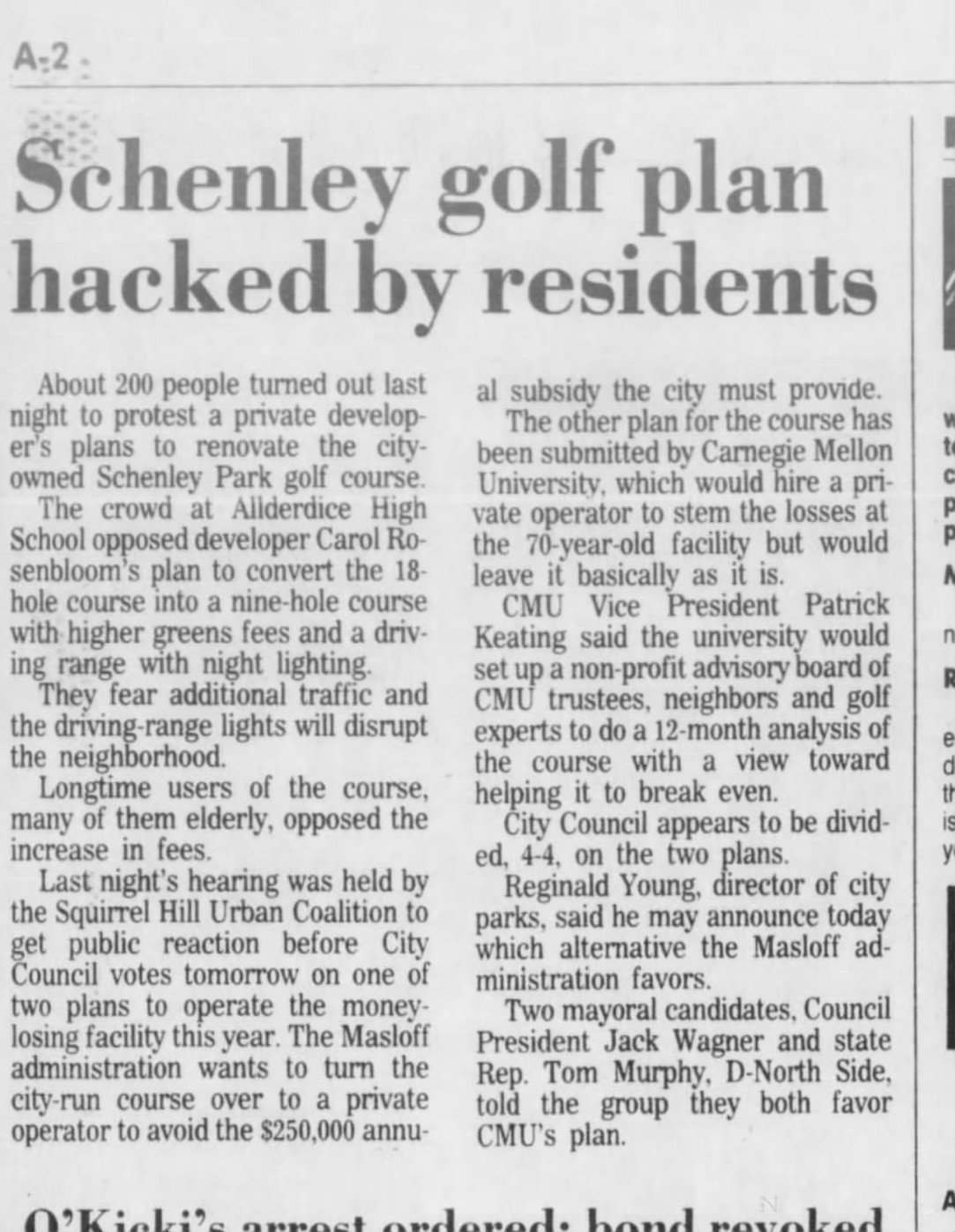
About 200 people turned out to protest … plans to renovate the city-owned Schenley Park golf course.
They fear that additional traffic and driving range lights would disrupt the neighborhood.
2007
Local Dispatch: The battle of Schenley Golf Course -- and how the people prevailed
Pittsburgh Post-Gazette
October 30, 2007
Trees cleared on golf course
Pittsburgh Post-Gazette
June 6, 2008
Friends of the Pittsburgh Urban Forest are criticizing the cutting of oaks in Schenley Park to benefit golfers. "Shocked would be a better word," said Ken Stiles, a board member of the urban forest group. "Cutting down 100-year-old healthy trees? Because they were getting in the way of golfers?"
Mike Gable, deputy director of the city's public works department, said First Tee wanted many more trees taken down than the city agreed to.
2008
2012
2020
Cervone and Farrow develop transformation plans for ‘The Bob’ - Architects propose to replace par-67 Pittsburgh muni with a nine-hole course and par-three layout.
Golf Course Architecture (Magazine)
August 14, 2020
*Note: A rendering of the course in this article includes placement of a “potential city parks maintenance bldg.” on the former 14th hole, across Circuit Drive from the current maintenance building.
Schenley Park golf course needs more business, councilman says
Pittsburgh Post-Gazette
September 24, 2012
The course has no space for a driving range. But if some holes were eliminated, [Corey] O’Connor said, the space could be used for a practice area. … The annual operating deficit is now less than $70,000, down from $150,000 as recently as 2008, Marc Field, executive director of the First Tee chapter said.
2026
"Neighbors organize against driving range"
Print. Pittsburgh's East End Newspaper
April 16 - May 13, 2026
Could Schenley Park’s golf course undergo a renovation? Here’s what’s being explored.
KDKA-TV (CBS News Pittsburgh)
August 17, 2026
‘I don’t want golf to take over the park’: Squirrel Hill residents push back on plans to upgrade Schenley Park golf course
Pittsburgh Tribune-Review
May 23, 2026
Golf course in Schenley Park aims for the green financially as neighborhood seeks input
Pittsburgh’s Public Source
June 11, 2026
Letter to the editor: What’s best for The Bob?Pittsburgh Post-Gazette
August 8, 2026
Brandon McGinley: Does golf belong in Schenley Park?
Pittsburgh Post-Gazette
August 14, 2026